Home → Journal → BEHIND THE SCENES
BEHIND THE SCENESThe gala: hosting, the Moroccan way
April 8, 20268 min read
Home → Journal → BEHIND THE SCENES
BEHIND THE SCENESA guest arrives at eight, walks a lit path, takes a glass, greets a few faces. He will see none of what follows. Yet at that precise moment, forty people have been working since dawn so that the next five hours pass without him having to think about them once.
A gala for two hundred guests is not put together in a few weeks. The date sets everything else: which venue is free, the season, which performers you can realistically hope for, and the availability of technical crews in a city where large evenings cluster into two periods of the year.
The first three months produce nothing visible. They serve to understand the intent: what this evening has to say, and to whom. A charity gala, an awards ceremony and a corporate anniversary follow logics with nothing in common, even though all three end with a dinner and a speech.
From three months out, everything rests on a single sheet: the minute-by-minute run of the day. It does not describe what should happen, but what will, with a named owner and a trigger for every line.
The rule we apply: every line of the schedule carries a name. A task with no named owner is a task nobody will do, and you only find out at the moment it is missing.
This is the least spectacular part and the riskiest. Who greets whom at the door. In what order the speeches follow. Where each guest of honour sits, and above all next to whom. A seating mistake cannot be recovered: it is noticed instantly and retold for a long time.
In Morocco, this work rests on precise customs that most international organisers do not know. Order of precedence, forms of address, the moment judged appropriate to speak: details that separate a successful evening from one that was merely well decorated.
“Protocol done well is invisible. Protocol done badly is all anyone sees.”
Our event director
A five-hour evening cannot hold one intensity throughout. Light divides it long before music does. Warm and low on arrival so conversations settle, clearer through dinner so people can see one another, tightened on stage for the speeches, then open and mobile for the second half.
These transitions are programmed to the second and triggered from the control desk on cue. Nobody in the room notices them, and that is exactly the intention: guests feel the evening moving, without knowing what moves it.
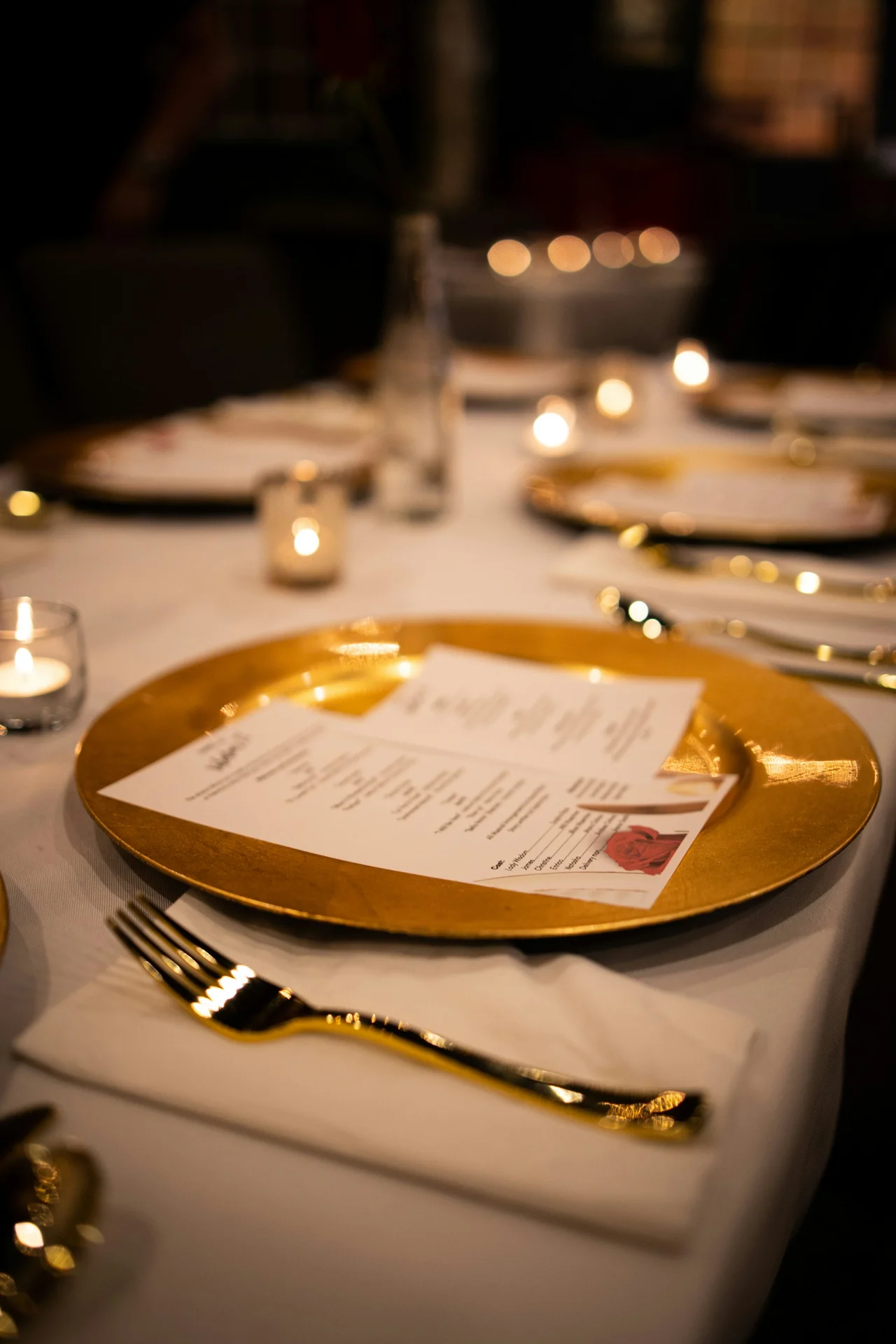
Two hundred covers served simultaneously demand a trained brigade, briefed the same day, and roughly one server for every twelve guests at a seated dinner. Below that, service stretches, plates cool, and the room notices within minutes.
The most common breaking point is not the kitchen, it is getting plates out. An undersized brigade loses twenty minutes over a dinner, and those twenty minutes cascade through the rest of the evening: speeches pushed back, performers waiting, guests leaving before the end.
We always hold a cold review in the days that follow, with the crews and with the client. Not to congratulate ourselves, but to log what nearly went wrong. That is almost always where the useful lessons sit, and rarely in what went well.
On our last gala for 180 guests, the gap between the planned run and the actual run was seven minutes across the whole evening. That is the figure we look at, not the photographs.
Hosting at this level is not a matter of decoration. It is a matter of preparation, protocol and people. If you are planning a gala in Marrakech, let us talk early: the best evenings are the ones that had time to be built.
About this article
Category
BEHIND THE SCENES
Published on
April 8, 2026
Reading time
8 min read
Inspired by this article? Let's talk about your project.
Contact usEvery great event begins with a conversation.
Request a consultation